
The Beaufort Wind Scale
It is often said that Francis Beaufort, of the British Royal Navy, was the first to devise a scale of wind force — towards the start of the 19th century. In fact, Beaufort did not really develop something new; but he did eventually succeeded in getting others to adopt his scale as a standard when there was no existing standard, primarily due to his position as British Admiralty Hydrographer of the Navy (which he held for 25 years).
A century earlier, in a book written in 1704 entitled The Storm: or, a Collection of the most Remarkable Casualties and Disasters which happened in the late Dreadful Tempest, both by Sea and Land, Daniel Defoe (who also wrote Robinson Crusoe), described a twelve-point "table of degrees" used by sailors of that day.
In 1801, Colonel Capper of the East India Company, in Observations on the winds and monsoons, reproduced “A table of the different velocities and forces of the winds, constructed by Mr Rous, with great care, from a considerable number of facts and experiments”.
Francis Beaufort devised his scale of wind force in 1805, when serving aboard HMS Woolwich. He first mentioned it in his private log on 13 January 1806, stating that he would, “hereafter estimate the force of the wind according to the following scale”. For many years, Beaufort’s scale of wind force was used only in his private logs. There is no mention of it in the official logs of HMS Woolwich or any other ships on which he served. The first published reference to Beaufort’s scales of wind force came in 1832, when the Nautical Magazine carried an article entitled “The Log Board”. A few years later, in December 1838, the Admiralty of the British Royal Navy dictated that all ships should keep hourly weather records, and should indicate the wind using the scale devised by Beaufort.
The initial criteria used for the scale was based on the canvas carried by a sailing ship at various wind speeds. For example, the criterion for Category 10, Whole Gale, was “With which she could only bear close-reefed maintop-sail and reefed fore-sail”. As dependence on sails waned, the Beaufort Scale was revised; and finally, in 1906, British Meteorologist George Simpson proposed the criteria should be the appearance of the sea at the various wind speeds. This modified Beaufort Scale was adopted by the International Meteorological Organization in 1939.
Following is the Beaufort Wind Scale in its current form, which now includes criteria for observations on land.
| Beaufort Scale | Wind Speed | Wave Ht (ft)* | Conditions At Sea | Conditions On Land | ||||||
| Knots | MPH | m/s | ||||||||
| 0 | Calm | less than 1 | less than 1 | 0.0 to 0.2 | none | Sea like a mirror. | Smoke rises vertically. | 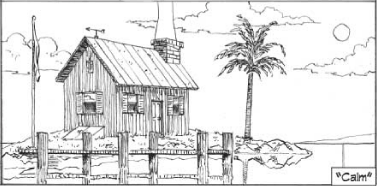
| ||
| 1 | Light Air | 1 to 3 | 1 to 4 | 0.3 to 1.5 | < ½ | Ripples with the appearance of scales are formed, but without foam crests. | Direction of wind is shown by smoke but not by wind vanes; leaves begin to rustle. | 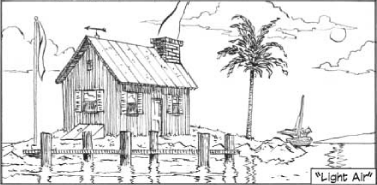
| ||
| 2 | Light Breeze | 4 to 6 | 5 to 7 | 1.6 to 3.3 | < 1 | Small wavelets, still short but more pronounced. Crests have a glassy appearance and do not break. | Wind felt on face; leaves rustle; ordinary vane moved by wind. | 
| ||
| 3 | Gentle Breeze | 7 to 10 | 8 to 11 | 3.4 to 5.4 | 2 (3) | Large wavelets. Crests begin to break. Foam of glassy appearance. Perhaps scattered whitecaps. | Leaves and small twigs in constant motion; wind extends light flag. | 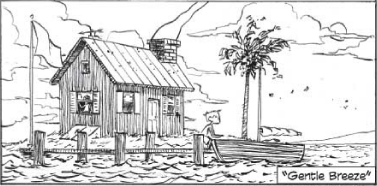
| ||
| 4 | Moderate Breeze | 11 to 16 | 12 to 18 | 5.5 to 7.9 | 3 (5) | Small waves, becoming longer, fairly frequent whitecaps. | Raises dust and loose paper; small branches are moved. | 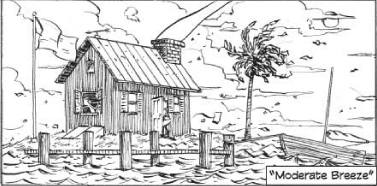
| ||
| 5 | Fresh Breeze | 17 to 21 | 19 to 24 | 8.0 to 10.7 | 6 (8) | Moderate waves, taking a more pronounced long form; many whitecaps are formed. Chance of some spray. | Small trees in leaf begin to sway; wavelets form on inland waters. | 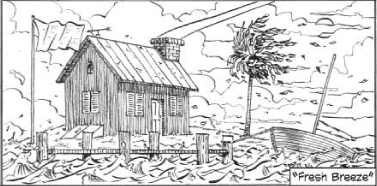
| ||
| 6 | Strong Breeze | 22 to 27 | 25 to 31 | 10.8 to 13.8 | 10 (13) | Large waves begin to form; the white foam crests are more extensive everywhere. Probably some spray. | Large branches in motion; whistling heard in overhead utility wires; umbrella use difficult; empty plastic bins tip over. | 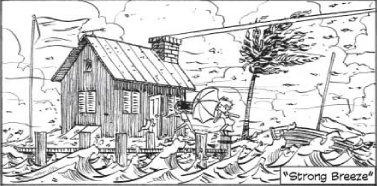
| ||
| 7 | Near Gale | 28 to 33 | 32 to 38 | 13.9 to 17.1 | 13 (18) | Sea heaps up and white foam from breaking waves begins to be blown in streaks along the direction of the wind. | Whole trees in motion; umbrellas discarded; inconvenience felt when walking. | 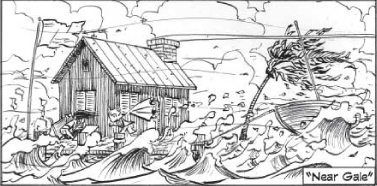
| ||
| 8 | Gale | 34 to 40 | 39 to 46 | 17.2 to 20.7 | 18 (25) | Moderate high waves of greater length; edges of crests begin to break into spindrift. The foam is blown in well-marked streaks along the direction of the wind. | Breaks twigs off trees; difficult to walk against the wind; vehicles buffeted while driving. | 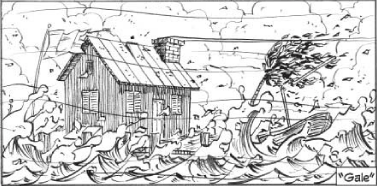
| ||
| 9 | Strong Gale | 41 to 47 | 47 to 54 | 20.8 to 24.4 | 23 (33) | High waves. Dense streaks of foam along the direction of the wind. Crests of waves begin to topple, tumble and roll over. Spray may affect visibility. | Some branches break off trees, and some small trees blow over. Construction/temporary signs and barricades blow over. | 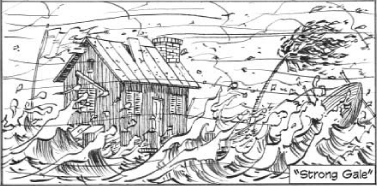
| ||
| 10 | Storm | 48 to 55 | 55 to 63 | 24.5 to 28.4 | 30 (41) | Very high waves with long over-hanging crests. The resulting foam, in great patches, is blown in dense white streaks along the direction of the wind. On the whole the surface of the sea takes on a white appearance. The “tumbling” of the sea becomes heavy and shock-like. Visibility affected. | Somes trees are broken off or uprooted; minor structural damage likely (e.g. some siding and shingles blown off). | 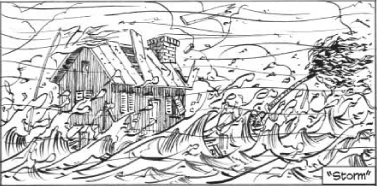
| ||
| 11 | Violent Storm | 56 to 63 | 64 to 72 | 28.5 to 32.6 | 38 (52) | Exceptionally high waves (small and medium-sized ships might be for a time lost behind the waves). The sea is completely covered with long white patches of foam lying along the direction of the wind. Everywhere the edges of the wave crests are blown into froth. Visibility affected. | Widespread damage to vegetation; structural damage likely. | 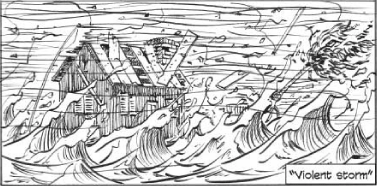
| ||
| 12 | Hurricane | 64 and over | 73 and over | 32.7 and over | 46 (-) | The air is filled with foam and spray. Sea completely white with driving spray; visibility very seriously affected. | Severe widespread damage to vegetation and structures. Debris and unsecured objects are hurled about. | 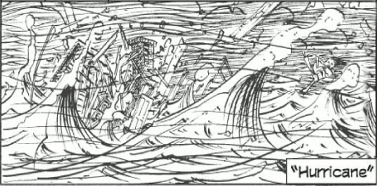
| ||
| * Top number is average wave height in open sea (i.e. far from shore); bottom number is maximum expected wave height. | ||||||||||
Sources
(UK) National Meteorological Library and Archive Fact Sheet 6 — The Beaufort Scale (pdf)
Howtoons — The Beaufort Scale (source for the pictures)
The Storm by Daniel Defoe (ebook)

|  IN-AL-99 |


